Why Computers Speak Binary
Discover why every computer on Earth uses binary — and why two-state electronics make it the only reliable choice.
Lesson Notes
Every computer is built from billions of tiny electronic switches. Each switch is either ON or OFF — so computers use binary: just two digits, 0 and 1.
How switches represent binary
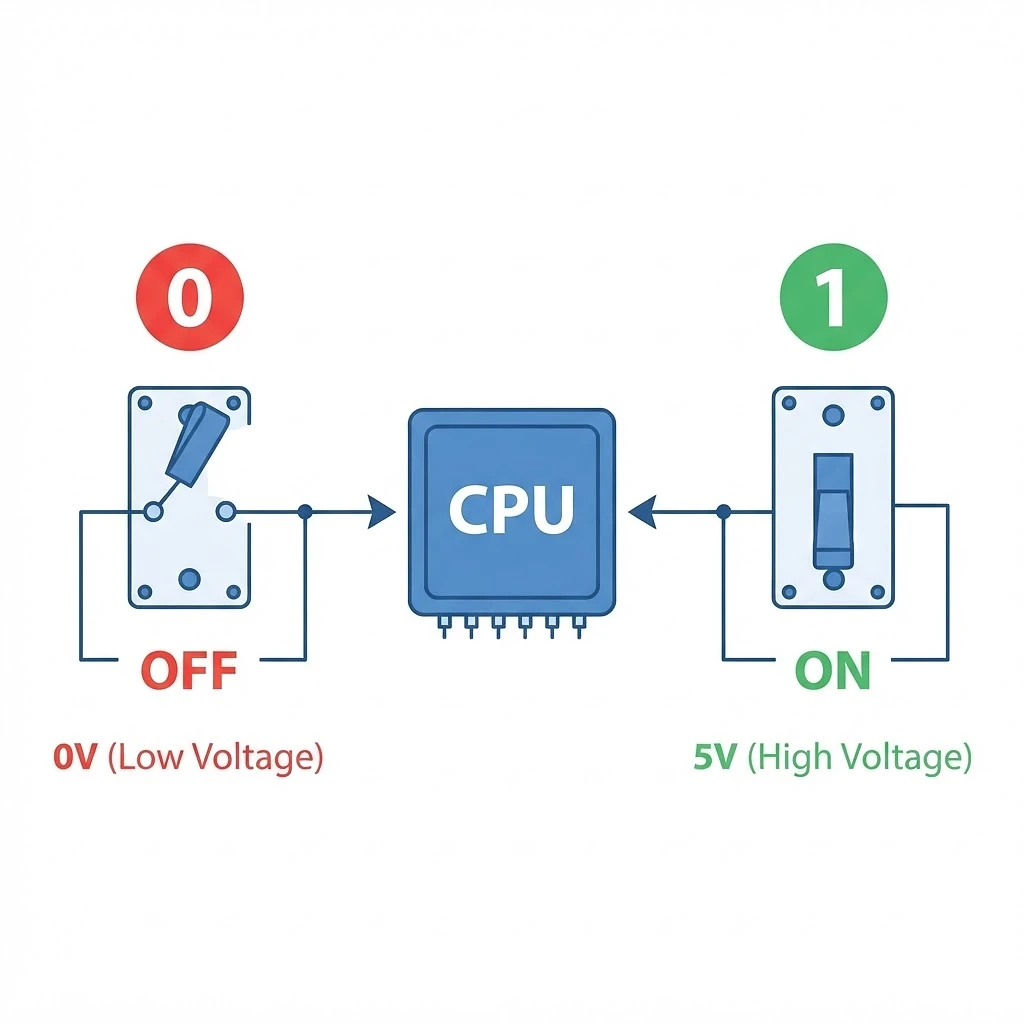
Each switch is either OFF (0, low voltage) or ON (1, high voltage).
A binary digit is called a bit. It can only be 0 or 1 — mapping perfectly to a switch: 0 = OFF, 1 = ON.
How voltage maps to binary
| Voltage level | Switch state | Binary digit |
|---|---|---|
| Low (around 0V) | OFF | 0 |
| High (around 5V) | ON | 1 |
Why not use denary (0–9)? To represent ten digits, a computer would need to detect ten different voltage levels. Tiny electrical noise could easily make one level look like another, causing errors.
Binary vs Denary in hardware
| Feature | Binary (2 states) | Denary (10 states) |
|---|---|---|
| Voltage levels needed | 2 (0V and 5V) | 10 (0V to 4.5V in steps) |
| Gap between levels | Large — easy to tell apart | Small — easy to confuse |
| Resistance to noise | High | Low |
| Circuit complexity | Simple | Complex |
| Cost | Cheap | Expensive |
A denary digit 7 is stored as 3.5V. Noise of 0.3V is present. What happens?
Exam Tip
If asked 'Why do computers use binary?': (1) electronic components naturally have two states (on/off), (2) two voltage levels are far apart and reliable, (3) binary circuits are simpler and cheaper to build.
Bits, nibbles, and bytes
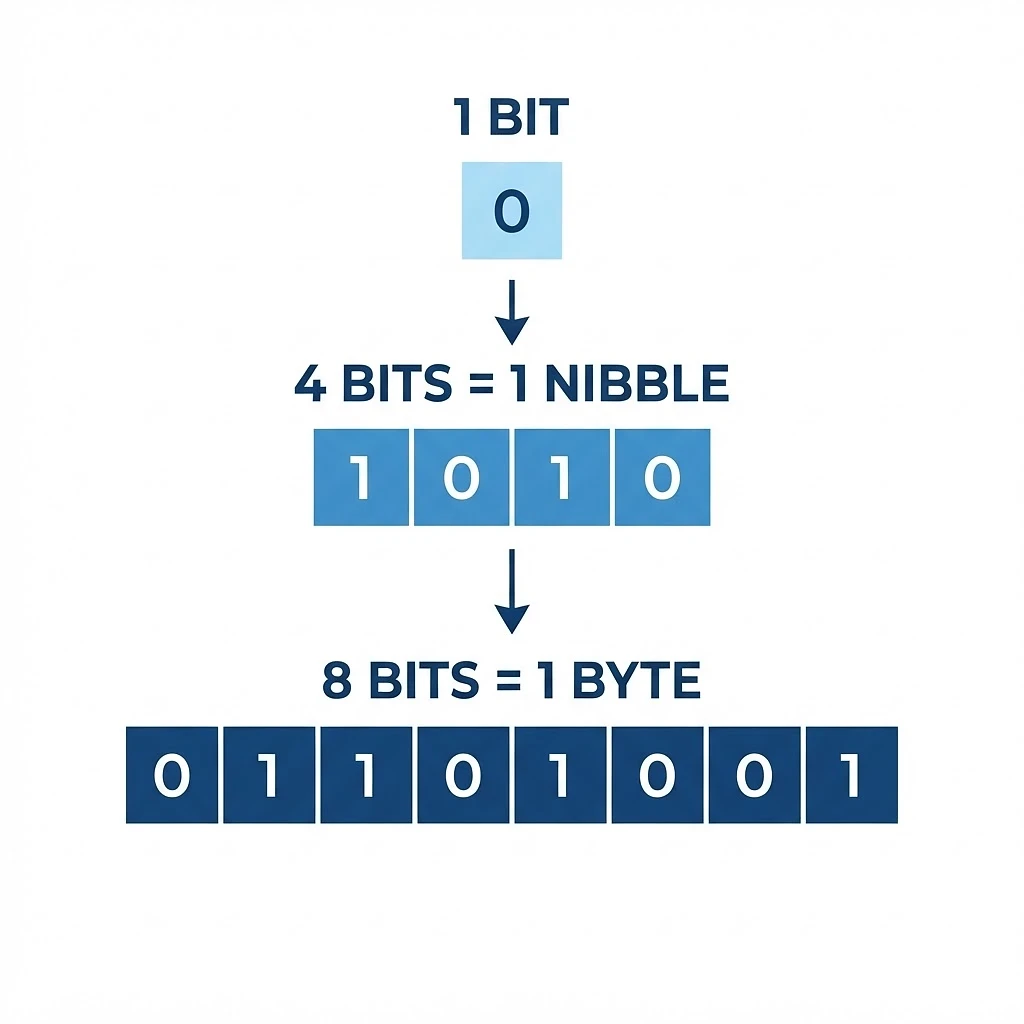
Bits are grouped into nibbles (4 bits) and bytes (8 bits) to represent larger values.
Units of binary data
| Unit | Number of bits | Example |
|---|---|---|
| Bit | 1 | 0 or 1 |
| Nibble | 4 | 1010 |
| Byte | 8 | 10101100 |
| Kilobyte (KB) | 1024 bytes | A short text message |
| Megabyte (MB) | 1024 KB | A song file |
Key formula: n bits can represent 2ⁿ different values. 8 bits → 2⁸ = 256 values (0 to 255).
How many values can 4 bits represent? What is the denary range?
Everything a computer stores — text, images, sound, code — is ultimately patterns of 0s and 1s.
Exam Tip
'Bit' comes from BInary digiT — 'bi' means two. This is a common one-mark question.
Activities
This is just one of 100+ lessons
Unlock all 10 units, flashcards, exam-style questions, and 6 timed mock tests. One payment, full access until your exam.
Enroll in the full courseWe use cookies for analytics and to improve your experience. You can choose what to allow. See our Privacy Policy.

